
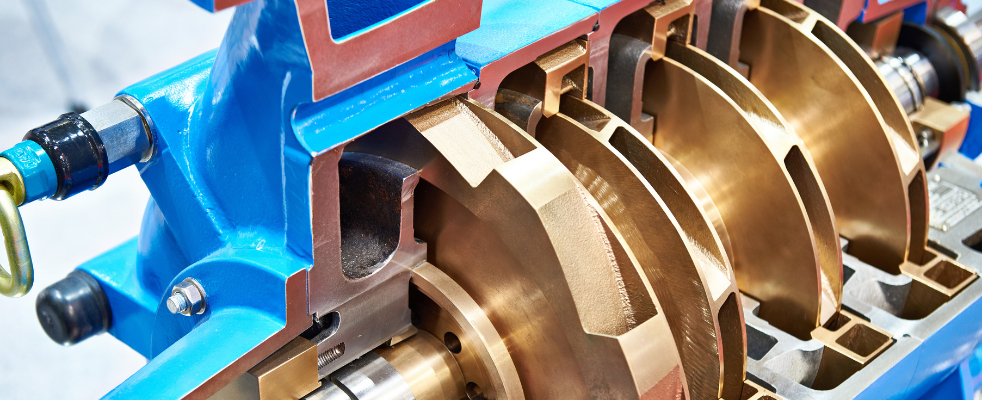
Known for their dependability and adaptability, centrifugal pumps are among the most widely used for industrial applications. Most systems call for either a single-stage or multistage design, each with its own advantages depending on pressure and flow requirements.
But what’s the difference and which one best fits your operating conditions and system demands?
Let’s break it down.
Key Differences in Single and Multistage Pumps
Both pumps use the same principles and can be made of the same materials, but their design and performance suit different applications. Below are key differences between two types of centrifugal pumps:
When to Select Single-Stage:
-
High Flow, Low Pressure: When high flow rates are needed at moderate pressures
-
Cost and Simplicity: Lower purchase, installation, and maintenance costs.
-
Space Constraints: Compact design suits smaller spaces.
When to Select Multi-Stage:
-
High Pressure, Low Flow: When high pressure is critical
-
Efficiency in High Head: More efficient for applications requiring significant pressure without excessive flow.
-
Scalability: Additional stages can be added for specific pressure nee
Trade-offs:
-
Single-stage: Less efficient for high-pressure needs; may require larger motors or multiple pumps.
-
Multi-stage: Higher cost and complexity; overkill for low-pressure, high-flow scenarios.
|
Feature |
Single-stage centrifugal pump |
Multi-stage centrifugal pump |
|
Impeller Count |
One |
Two or More |
|
Pressure Head |
Low to moderate |
High |
|
Construction |
Simple design |
Complex design |
|
Maintenance |
Easier to manage with fewer parts |
More involved, more components |
|
Cost |
Lower upfront cost |
Higher upfront cost with better long-term efficiency |
|
Space Requirements |
More compact |
Often requires more space |
|
Flow Rate |
High Flow at low pressure |
High pressure at lower flow rates |
|
Head Range |
10–150 meters (33–492 feet). |
Can exceed 1,000 meters (3,280 feet) depending on stages. |
Key Considerations:
-
Head and Flow Requirements: Match pump type to system demands (single-stage for high flow, multi-stage for high head).
-
Cost: Single-stage is cheaper upfront and easier to maintain.
-
Space and Complexity: Multi-stage pumps are larger and require more maintenance expertise.
-
Energy Efficiency: Multi-stage pumps are more energy-efficient for high-pressure applications.
Common Applications for Single Centrifugal Pumps
Cooling and Circulation
Single-stage centrifugal pumps move water or coolant through chillers, condensers, and heat exchangers. They’re often used for temperature control in power plants, manufacturing facilities, and large commercial buildings
Chemical Process
Single-stage centrifugal pumps transfer fluids, water, and weak chemicals through processing and production lines. To maintain product purity and efficiency, these pumps can be made from stainless steel or specialized alloys, allowing them to handle mildly aggressive fluids without corroding or wearing quickly.
Petrochemical and Oil and Gas
Petrochemical and oil and gas facilities rely on single-stage centrifugal pumps to move fluids in a range of applications such as petroleum transfer, water injection or pipeline boosting. The simple, durable design lets them handle the various viscosities and temperatures often encountered in refining and production operations.
Food and Beverage
Single-stage centrifugal pumps transfer products like water, juice, milk, and brewing fluids through processing equipment in the food and beverage industry. They’re designed to minimize shear and avoid damaging delicate components, helping to maintain product texture and taste. Often constructed from sanitary materials such as stainless steel, making them easy to clean and sterilize.
Wastewater and Drainage
Single-stage centrifugal pumps move raw wastewater, treated water, or stormwater through treatment facilities and into disposal or reuse systems. Durable materials and simple designs allow them to handle fluids with small amounts of suspended particles. They perform well under variable flow conditions and can operate with minimal supervision.
General Industrial Services
single-stage centrifugal pumps serve a range of utility applications such as manufacturing, mining, and pulp and paper. They’re frequently used for water transfer, pressure boosting, and circulation tasks.
Working with similar applications? Reach out to explore your options. Get in touch today.
Common Applications for Multistage Centrifugal Pumps
Boiler Feed Water
Multistage centrifugal pumps are often used to feed water into steam boilers in power stations and industrial plants. The multistage design lets them generate high pressure from relatively low flow. You can achieve a reliable steam supply by raising the water pressure within the boiler, a task well-suited for multistage centrifugal pumps.
Reverse Osmosis (RO) Water Treatment
In water treatment and desalination applications, multistage centrifugal pumps provide the pressure needed to push water through reverse osmosis membranes. Multistage pumps can help produce clean water from brackish or seawater sources.
Pressure Boosting in Industrial Processes
Some industrial applications, like manufacturing or food processing, require consistent, elevated pressure to operate equipment. Multistage centrifugal pumps boost pressure to match these process requirements in use cases like cleaning, spraying, or production lines. Reliable pressure delivery can make multistage pumps a key part of many production operations.
High-rise Building Water Supply
Multistage centrifugal pumps are used to deliver water to upper floors of tall buildings and residential towers. They produce the pressure required to lift water vertically against gravity. The multistage configuration lets designers match flow and pressure to the specific needs of the building’s height and usage.
Can't Decide Which Is Right for You?Let’s get your operation the right solution. Get a quote from our team today. |
Contact Us |