
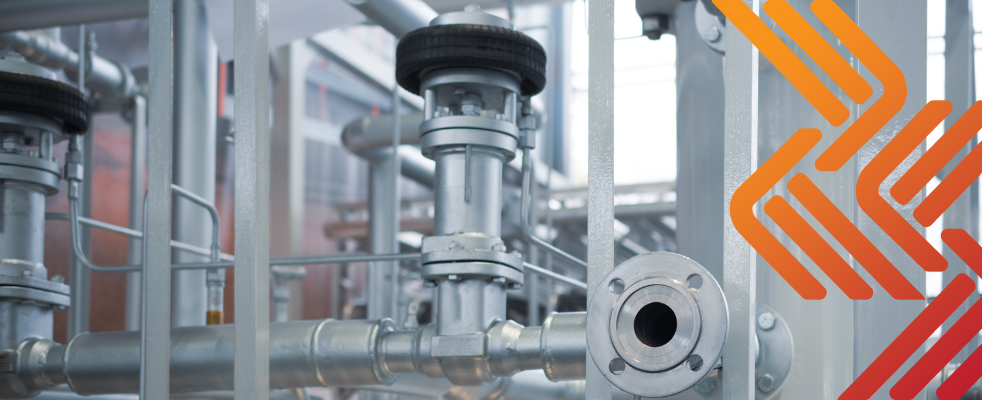
Valves play an important part in biotech and pharmaceutical systems by maintaining precise control, safety, and sterility across every stage of processing.
Here you’ll find an overview of the various valve types used throughout the industry, and we’ll also pinpoint which valves align best with specific product categories and process needs.
Sanitary Ball Valves
Benefits in biotech and pharma:
-
Easy maintenance
-
Reduced downtime
-
Support GMP compliance
Sanitary ball valves are among the most versatile valve types used in hygienic applications. They feature a polished stainless-steel body and a full-bore design, allowing unobstructed flow and easy cleaning.
These valves are particularly effective for transferring high-purity liquids such as sterile water or buffer solutions. Their simple quarter-turn operation offers quick shutoff and minimal dead space, important for maintaining cleanliness and avoiding product retention.
Soft-Seated Ball Valves
Benefits in biotech and pharma:
-
Leak-proof performance
-
No risk of contamination
-
Support GMP compliance
Soft-seated ball valves use materials such as PTFE (teflon) for the seat, providing a tight seal that doesn’t let any liquid through. In biotech and pharmaceutical systems, they are ideal for processes requiring both chemical compatibility and this leak-proof performance.
Their design ensures minimal leakage, even under fluctuating pressure and temperature conditions. This not only protects product integrity but also limits waste and contamination risks. Soft-seated ball valves are often selected for transferring cleaning agents, solvents, and process chemicals where precision and cleanliness are paramount.
Control Valves
Benefits in biotech and pharma:
-
Integration allows for real-time adjustments to enhance efficiency
-
Can be fine-tuned to exact environmental conditions
Control valves regulate flow, pressure, or temperature in a process, ensuring that conditions remain stable and within tight tolerances. In biotechnology, where processes like fermentation or chromatography rely on exact environmental conditions, control valves provide the precision necessary for consistent yields and product quality.
The ability of a business to fine-tune the system performance of these valves minimizes waste and energy use, leading to cost savings while maintaining regulatory compliance.
Sanitary Diaphragm Valves
Benefits in biotech and pharma:
-
Cost-effective
-
Hygienic
-
Chemical resistance to aggressive media
Sanitary diaphragm valves are the gold standard for aseptic processes. Using a flexible diaphragm to separate the valve body from the process media, they ensure zero contamination and complete isolation of the product stream.
These valves are widely used in bioreactors, filtration systems, point of use, and filling lines. Their design allows seamless integration with CIP and SIP protocols, making them ideal for high-purity and sterile operations. Beyond hygiene, diaphragm valves offer excellent flow control in biotech and pharmaceutical industries.
They come in single or multi-port configurations for versatile installation, and their ease of cleaning makes them essential in modern pharmaceutical facilities.
Solenoid Valves
Benefits in biotech and pharma:
-
Automation readiness
-
Integrate easily into digital control systems
-
reduce manual intervention
Solenoid valves use electromagnetic coils to control the opening and closing of the valve, offering fast and precise flow regulation. In biotech and pharmaceutical processes, they are frequently used in automated systems (think dosing, sampling, or gas handling) where responsiveness is critical.
Their main strengths are automation readiness, compact size, and low power consumption. For manufacturers focusing on smart production and process optimization, solenoid valves deliver consistent performance and enhanced control.
Check Valves
Benefits in biotech and pharma:
-
Prevent reverse flow of fluids
-
Reduce cross-contamination
Check valves, also known as non-return valves, allow fluid to flow in only one direction. This prevents backflow that could compromise a sterile system or contaminate a batch.
Their main advantages lie in reliability and protection. By automatically preventing reverse flow, check valves maintain the integrity of critical systems without the need for external controls. In biotech environments, this is especially important as it means a reduced risk of cross-contamination and a lower maintenance overhead. This makes them an indispensable valve option for high purity flow control solutions.
Pinch Valves
Benefits in biotech and pharma:
-
Simple construction allows for rapid replacement of the tube
-
Traditionally long service life in demanding conditions
Pinch valves operate by compressing a flexible tube to stop or regulate flow, ensuring that only the inner tube contacts the fluid. This makes them particularly valuable for handling delicate or abrasive materials in sterile environments.
In biotechnology, they are often used with cell cultures, slurries, or viscous fluids where gentle handling is essential. Businesses in this demanding industry will benefit from their clean operation, reduced downtime, and long service life.
Sanitary and Lined Butterfly Valves
Benefits in biotech and pharma:
-
Hygienic
-
Chemical resistance to aggressive media
We typically only see lined valves in Active Pharma production, which makes them a less common option, but their benefits for the industry are still worth mentioning.
Butterfly valves control flow through a rotating disc mechanism and are valued for their compactness and efficiency. In sanitary and lined configurations, they are particularly suited to low- to medium-pressure applications such as water distribution, clean-in-place systems, and ingredient handling.
The sanitary design minimizes microbial buildup, while PTFE or EPDM linings provide chemical resistance for aggressive media.
Safety Relief Valves (Conventional Spring Type)
Benefits in biotech and pharma:
-
Prevent catastrophic overpressure situations
Safety relief valves are critical for protecting both equipment and personnel. The conventional spring type uses a calibrated spring mechanism that opens when system pressure exceeds a set limit, releasing excess fluid or gas safely.
In pharmaceutical and biotech facilities, these valves are commonly installed on vessels, autoclaves, and reactors.
Selecting the appropriate valve for each application is a decision that directly influences product purity, process efficiency, and operational cost.
By understanding how each valve works and where it excels, we hope you’ve gained the information you need to see how valves can fit with systems in modern life science production.